This chapter discusses some practical tools every developer should use, with a high level of proficiency. They aren’t the be-all, end-all of being a developer, but they are very good at what they can do.
Plain Text
They provide a compelling argument that using plain text is important. It can be structured (JSON, YAML) or unstructured. In either version, it should be written in a `human-readable` format, not just be human understandable. The difference here is that a random string of letters and numbers is understandable to a human, but it isn’t readable, where the reader can gain insights or understanding.
Shells
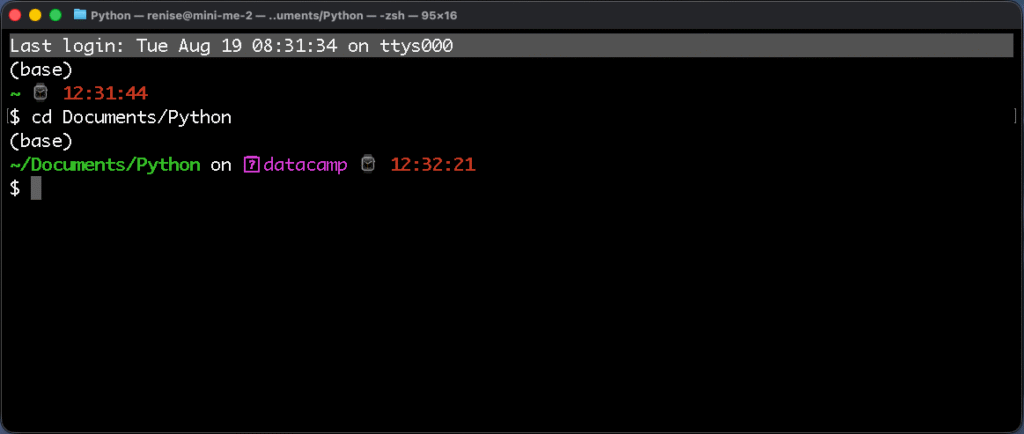
They advise having a bias towards using Shells versus IDEs as much as possible. They are the `workbench` for manipulating files. They can, of course, be customized to your preferences. For example, my shell in Terminal (macOS) will display the current folder and git branch in one line above the cursor.
You can also use aliases to help automate repeated operations to avoid having to retype them manually. For example, I used ZSH at Amazon to create shortcuts for specific terminal commands and options to improve my workflow.
Another useful tip is to leverage command completion. I use command completion all the time, especially when working with Git. I can easily recall previous commands and do path completion when navigating folders and files in Terminal.
My training and work as an engineer at Amazon were more focused on learning to use an IDE (IntelliJ). There was some command-line work, but it wasn’t the bulk of it. As one engineer mentioned to me, today, it’s easier to use a chatbot to learn command-line prompts and shortcuts. We no longer have to memorize them.
Debugging
They offer some sage advice on how to approach debugging without panicking. When I was a new developer, it was definitely panic-inducing to get paged for an issue in a large codebase I was unfamiliar with. I can recall the feelings of helplessness even today.
Their advice, “don’t panic!”
Instead, start to develop a problem-solving strategy for how to squash bugs:
First, develop a debugging mindset. Remind yourself that it’s only problem-solving
Start with a clean build. If the build isn’t clean, don’t even bother starting to debug.
Gather relevant data. Depending on the issue, it could be dashboards, logs, or user-reported information.
Reproduce them. Recreate the bug to help gain a better understanding of what’s going on and where to begin investigating.
Write a failing test before fixing a bug. This one is self-explanatory.
Figure out if it’s a crash, a bad result, or input-value sensitivity. Knowing which one is a good starting point.
Use binary chop. Similar to a binary search, halve the stack until you isolate the problem.
Binary Chop
I hadn’t heard of this methodology until now. It’s a simple idea that makes sense. Instead of trying to trace a stack with hundreds of lines of information, cut it in half. See if the problem occurs in that half, then continue dividing the stack until the bug’s origin is found. It’s the debugging version of a binary search method.
Many times, I remember seeing a stack trace of an issue at Amazon, consisting of hundreds of lines. This strategy would have been useful back then, but of course, hindsight is 20/20.
Process of Elimination
Identify whether the bug is in your code, a framework from a vendor, or the environment the code runs in. Don’t bypass testing simple lines of code because you assume it’s too simple to cause a bug. Such assumptions will cost time and effort that could be avoided.
Engineer’s Daybook
One advice that I enjoyed reading is their advice to use an engineering daybook. In today’s parlance, it’s a bullet journal, or something similar. It’s a place where you can jot down and reference notes as you go through the day. Later, these can be referenced for a look back in time or to discover new ideas and solutions. I give a big plus one to this.
Conclusion
I found chapter three to be very practical, with tangible advice that an engineer can start implementing immediately. Most of the tools mentioned are free or easy to get. They do require time and commitment to reach a high level of fluency, but are worth the effort, even on a basic level.
I found this chapter to be insightful and can relate it to my experience as an engineer, both good and bad. The chapter discusses good design, DRY, tracer code, prototyping, and estimating. I’ll share what I learned along with my thoughts.
Easy To Change (ETC)
The chapter begins with a discussion on what makes good design. They emphasize the benefits of good design, including that it must be changeable without changing any adjacent, upstream, or downstream code. In essence, use ETC or make it easier to change by using techniques such as modularization and interfaces to keep responsibilities separate.
ETC is more than just applying the Single Responsibility Principle. *Thomas* and *Hunt* advocate that it’s a value for decision-making. It won’t tell you how to design and implement systems, but it will help you make better decisions between design and implementation options.
When dealing with unknown paths or novel projects, their sage advice is to make it replaceable. That way, if a better design option is presented later, that chunk of code can be quickly replaced. In their words, your initial design or implementation decision “won’t be a roadblock” to implementing the better option.
Finally, be sure to note the situation and reasoning in a journal and code to be able to understand and reflect on your decision later. This is wise advice for me. I didn’t keep meta notes, and I feel this bit of wisdom is helpful to grow as an engineer.
Don’t Repeat Yourself (DRY)
They emphasize that DRY, or Don’t Repeat Yourself, applies to both code and documentation. If a change has to be made in multiple locations, then the code isn’t DRY. For example, having a function where multiple lines use the same steps to perform a calculation. In this case, remove the repetition by moving those steps to a separate function that can be used by each operation. Even low-level operations such as number and text formatting should be converted to a reusable function call, rather than repeating the operation multiple times in the code.
This also means that documentation in the code shouldn’t be a copy of what’s in the code. This will lead to the documentation and the code becoming misaligned in the future because, as the code changes, it’s more likely that the documentation won’t be updated. Instead, use documentation to highlight an exception, a known issue to fix later, or to explain an engineering decision.
Duplication should also be avoided between APIs (internal and external) and data sources. The goal is to find a neutral standard to specify APIs or data.
Orthagonality
They introduce the concept of *orthogonality* in programming with an example of the systems used to control a helicopter in flight. The controls on a helicopter aren’t independent; moving one lever will affect how the other controls should be manipulated. You cannot move the cyclic to get it to move forward without having to adjust the pitch lever, throttle, and foot pedals.
The interplay of a helicopter’s systems is an example of a non-orthogonal system where each is intricately intertwined such that you can’t adjust one without adjusting the others. This is not how code should perform.
Each system should operate independently of the other. This makes code changes easier, saves time, and reduces risk because an engineer will understand that they only need to create and test the change in one system (or subsystem). It also promotes component reuse, where new and creative combinations can be made in the future.
During the design process, maintain orthogonality by using implementation layers. That is, the user interface is developed separately from the data access layer, which is separate from authorization and any business logic. A quick check they advise is to ask yourself, ‘If I dramatically change the requirements behind a particular function, how many modules are affected?’
Also, be mindful of how your design is decoupled from the real world. For example, using randomly generated IDs for user account IDs instead of real-world information such as phone numbers, because they can change, and you will not have control over them.
And of course, this also applies to documentation where content and presentation are separated. It is best to have a platform that handles the presentation layer, such as Markdown, so that you can focus on the content.
Tracer Code
An interesting tool they mention is to use tracer code. Tracer code is where a system is developed just enough to get each layer working together end-to-end to show that the system as a whole can be integrated. This is especially important for novel projects where the possibilities are unknown. The tracer code is developed in the same environment it needs to run in, within the same constraints. It gets from the requirement to an operational but simplified version of the system running quickly. From there, developers can add to each subsystem until all requirements are implemented.
It avoids the burden of developing all the requirements at once without anything to demo until much later. Tracer code helps to demonstrate to all stakeholders that the project is viable and will encourage buy-in and support for the rest of the implementation. Tracer code is skeleton system code that can be used to implement the rest of the functionality.
Prototypes
Prototypes, on the other hand, are meant to be disposable. It is a way to demo or work out a specific problem without producing production code. It can be done on sticky notes, a computer, or a small-scale model. The ultimate difference between tracer code and a prototype is that a prototype can be discarded.
Estimating
Finally, they discuss estimating and how to get a better handle on setting time frames for project task completion. They suggest referencing prior projects or talking to engineers who have experience with this type of project, which is important wisdom to have.
They mention how to talk about and reference estimation to set expectations. For example, if a project is estimated to take 25 weeks to complete, set the duration to six months. That way, the expectation is to have it done in 5-7 months. This will provide 1-3 months of wiggle-room versus 1-3 weeks, which is a significant difference.
They also suggest building a model of the steps needed to understand what needs to be done. The goal is to make sure you have a good understanding of how your team or organization develops projects.
They advise keeping a journal of your estimations to reference and reuse later. As an engineer, this is an area that I struggled with. It is challenging to set a task estimate of work you haven’t done before on a team that provides little guidance and shared estimating knowledge. It can feel daunting.
They advocate for my preferred method of project task planning and estimation. This method broadly defines all but the initial tasks. Then, as project implementation progresses, progressively refine the remaining tasks in parallel. In my role at Amazon, I was expected to create a firm, detailed task plan as a new engineer, regardless of my experience and uncertainty, and then not deviate from that plan. This method meant that revisions to my timeline had a high negative impact without much guidance.
Conclusion
Overall, my previous experience resonated with what Thomas and Hunt advise. I honestly feel that this book should be a required reading for new engineers because it gives them access to wisdom gained from years of experience, whether their team can provide it or not. It is a way to build a strong foundation as an engineer that can be referred to and refined over time.
I am looking forward to reading each chapter of this book. Coming up next, chapter three, entitled The Basic Tools.
Continuing with chapter one, section seven (7) on communication. Thomas and Hunt offer advice on how to be a better engineer by communicating more effectively.
The section begins by advising that it’s “not just what you’ve got, but also how you package it”. They caution that even the best code or ideas are useless unless other people are aware of them.
Developers create various forms of communication, including in meetings, through written code, proposals, and reports. When preparing non-code communication, treat your native language like a programming language by honoring the DRY principle and leveraging automation. Automation in this case can include any documentation templates.
For code, inline documentation should focus on why a decision is made. It shouldn’t explain how because that’s what the code is for.
Know your audience: They caution, “just talking isn’t enough”. You must understand the needs and capabilities of your audience, and request audience feedback to gauge their level of understanding and engagement.
Know what you want to say: Create a plan for what you want to say to ensure it expresses what you want in all communication types, including verbal communication.
Choose your moment: Figure out if your audience is receptive to your ideas before you start sharing them by understanding their priorities.
Choose a style: Understand how your audience wants the information delivered – a formal document, quick details, or a verbal discussion.
Make it look good: A good-looking document matters, so take the time to edit and format your communication to make an impact.
Involve your audience: Get readers engaged early in the documentation process.
Be a listener: Listen to others as you would have them listen to you.
Get back to people: Whether it’s email, social media, or documentation comments, there’s no excuse not to respond.
Documentation Best Practices They nicely devote a separate section for documentation, and as a fan of technical writing, it pleased me to see it.
Don’t waste time documenting how in your code, document why.
Comment source code to explain parts of a project or engineering trade-offs.
Plan your documentation from the start, not as an afterthought.
It’s generally understood that we all need to communicate better. It’s a persistent challenge given all the other priorities we face every day. But it’s worth taking the time to communicate effectively. These engineering communication tips are shared with a voice of experience from both authors.
I finally got the chance to start reading The Pragmatic Programmer, 20th Anniversary Edition by David Thomas and Andrew Hunt. These are my initial notes from this first reading.
These are my rough notes and are intended for me to reflect on what I read. I capture the key points that I feel are important to pay attention to.
Attitude and Style
Think beyond the immediate problem.
Place it in a larger context.
Seek the bigger picture.
Team Trust
The team needs to trust me.
Own It
Look for risks beyond my control.
Have contingency plans for risks.
Know my options such as: prototyping, testing, automation, and learning.
Software Entropy
Fix ‘broken windows’ quickly.
Document issues as soon as they are known.
Don’t do additional harm while fixing additional issues.
This is the first assigned codelab on day four of the intensive. Download it here from Github to run locally or run in this Kaggle notebook.
"""Use Google Search in Generation

Google Gen AI 5-Day Intensive Course
Host: Kaggle

Day: 4

Codelab: https://www.kaggle.com/code/markishere/day-4-google-search-grounding
"""

import io
import os
from pprint import pprint

from google import genai
from google.api_core import retry
from google.genai import types
from IPython.display import HTML, Image, Markdown, display

client = genai.Client(api_key=os.environ["GOOGLE_API_KEY"])

# Define a retry policy. The model might make multiple consecutive calls automatically
# for a complex query, this ensures the client retries if it hits quota limits.
is_retriable = lambda e: (
    isinstance(e, genai.errors.APIError) and e.code in {429, 503}
)

if not hasattr(genai.models.Models.generate_content, "__wrapped__"):
    genai.models.Models.generate_content = retry.Retry(predicate=is_retriable)(
        genai.models.Models.generate_content
    )

# To enable search grounding, specify it as a tool 'google_search'
# as a parameter in `GenerateContentConfig` passed to `generate_content`

# Ask for information without search grounding
response = client.models.generate_content(
    model="gemini-2.0-flash",
    contents="When and where is Billie Eilish's next concert?",
)
Markdown(response.text)

# And now rerun the same query with search grounding enabled.
config_with_search = types.GenerateContentConfig(
    tools=[types.Tool(google_search=types.GoogleSearch())]
)


def query_with_grounding():
    response = client.models.generate_content(
        model="gemini-2.0-flash",
        contents="When and where is Billie Eilish's next concert?",
        config=config_with_search,
    )

    return response


rc = query_with_grounding()
Markdown(rc.text)


# Response metadata
# Get links to search suggestions, supporting documents and information
# on how they were used.
while (
    not rc.grounding_metadata.grounding_supports
    or not rc.grounding_metadata.grounding_chunks
):
    # If incomplete groundind data was returned, retry.
    rc = query_with_grounding()

chunks = rc.grounding_metadata.grounding_chunks
for chunk in chunks:
    print(f"{chunk.web.title}: {chunk.web.url}")

HTML(rc.grounding_metadata.search_entry_point.rendered_content)

supports = rc.grounding_metadata.grounding_supports
for support in supports:
    pprint(support.to_json_dict())

markdown_buffer = io.StringIO()

# Print the text with footnote markers.
markdown_buffer.write("Supported text:\n\n")
for support in supports:
    markdown_buffer.write(" * ")
    markdown_buffer.write(
        rc.content.parts[0].text[
            support.segment.start_index : support.segment.end_index
        ]
    )

    for i in support.grounding_chunk_indices:
        chunk = chunks[i].web
        markdown_buffer.write(f"<sup>[{i + 1}]</sup>")

    markdown_buffer.write("\n\n")

# Print footnotes.
markdown_buffer.write("Citations:\n\n")
for i, chunk in enumerate(chunks, start=1):
    markdown_buffer.write(f"{i}. [{chunk.web.title}]({chunk.web.url})\n")

Markdown(markdown_buffer.getvalue())


# Search with tools
# Use Google search grounding and code generation tools
def show_response(response):
    for p in response.candidates[0].content.parts:
        if p.text:
            display(Markdown(p.text))
        elif p.inline_data:
            display(Image(p.inline_data.data))
        else:
            print(p.to_json_dict())

        display(Markdown('----'))

config_with_search = types.GenerateContentConfig(
    tools=[types.Tool(google_search=types.GoogleSearch())],
    temperature=0.0
)

chat = client.chats.create(model='gemini-2.0-flash')

response = chat.send_message(
    message="What were the medal tallies, by top-10 countries, for the 2024 Olympics?",
    config=config_with_search
)

show_response(response)

config_with_code = types.GenerateContentConfig(
    tools=[types.Tool(code_execution=types.ToolCodeExecution())],
    temperature=0.0
)

response = chat.send_message(
    message="Now plot this as a Seaborn chart. Break out the medals too.",
    config=config_with_code
)

show_response(response)
This is the first assigned codelab on day four of the intensive. Download it here from Github to run locally or run in this Kaggle notebook.
"""Tune Gemini Model for Custom Function

Google Gen AI 5-Day Intensive Course
Host: Kaggle

Day: 4

Codelab: https://www.kaggle.com/code/markishere/day-4-fine-tuning-a-custom-model
"""

import datetime
import email
import os
import re
import time
import warnings
from collections.abc import Iterable

import pandas as pd
import tqdm
from google import genai
from google.api_core import retry
from google.genai import types
from sklearn.datasets import fetch_20newsgroups
from tqdm.rich import tqdm as tqdmr

client = genai.Client(api_key=os.environ["GOOGLE_API_KEY"])

for model in client.models.list():
    if "createTunedModel" in model.supported_actions:
        print(model.name)

newgroups_train = fetch_20newsgroups(subset='train')
newgroups_test = fetch_20newsgroups(subset='test')

# View list of class names for dataset
newsgroups_train.target_names
print(newsgroups_train.date[0])

def preprocess_newsgroup_row(data):
    # Extract only the subject and body.
    msg = email.message_from_string(data)
    text = f'{msg["Subject"]}\n\n{msg.get_payload()}'
    # Strip any remaining email addresses
    text = re.sub(r"[\w\.-]+@[\w\.-]+", "", text)
    # Truncate the text to fit within the input limits
    text = text[:40000]

    return text

def preprocess_newsgroup_data(newsgroup_dataset):
    # Put the points into a DataFrame
    df = pd.DataFrame(
        {
            'Text': newsgroup_dataset.data,
            'Label': newsgroup_dataset.target
        }
    )
    #  Clean up the text
    df['Text'] = df['Text'].apply(preprocess_newsgroup_row)
    # Match label to target name index
    df['Class Name'] = df['Label'].map(lambda l: newsgroup_dataset.target_names[l])

    return df

# Apply preprocessing to training and test datasets
df_train = preprocess_newsgroup_data(newgroups_train)
df_test = preprocess_newsgroup_data(newgroups_test)

df_train.head()

def sample_data(df, num_samples, classes_to_keep):
    # Sample rows, selecting num_samples of each label.
    df = (
        df.groupby('Label')[df.columns]
        .apply(lambda x: x.sample(num_samples))
        .reset_index(drop=True)
    )

    df = df[df['Class Name'].str.contains(classes_to_keep)]
    df['Class Name'] = df['Class Name'].astype('category')

    return df

TRAIN_NUM_SAMPLES = 50
TEST_NUM_SAMPLES = 10
# Keep rec.* and sci.*
CLASSES_TO_KEEP = '^rec|^sci'

df_train = sample_data(df_train, TRAIN_NUM_SAMPLES, CLASSES_TO_KEEP)
df_test = sample_data(df_test, TEST_NUM_SAMPLES, CLASSES_TO_KEEP)

# Evaluate baseline performance
sample_idx = 0
sample_row = preprocess_newsgroup_row(newsgroups_test.data[sample_idx])
sample_label = newsgroups_test.target_names[newsgroups_test.target[sample_idx]]

print(sample_row)
print('---')
print('Label:', sample_label)

response = client.models.generate_content(
    model='gemini-1.5-flash-001',
    contents=sample_row
)
print(response.text)


# Ask the model directly in a zero-shot prompt.

prompt = "From what newsgroup does the following message originate?"
baseline_response = client.models.generate_content(
    model="gemini-1.5-flash-001",
    contents=[prompt, sample_row])
print(baseline_response.text)


# You can use a system instruction to do more direct prompting, and get a
# more succinct answer.

system_instruct = """
You are a classification service. You will be passed input that represents
a newsgroup post and you must respond with the newsgroup from which the post
originates.
"""

# Define a helper to retry when per-minute quota is reached.
is_retriable = lambda e: (isinstance(e, genai.errors.APIError) and e.code in {429, 503})

# If you want to evaluate your own technique, replace this body of this function
# with your model, prompt and other code and return the predicted answer.
@retry.Retry(predicate=is_retriable)
def predict_label(post: str) -> str:
    response = client.models.generate_content(
        model="gemini-1.5-flash-001",
        config=types.GenerateContentConfig(
            system_instruction=system_instruct),
        contents=post)

    rc = response.candidates[0]

    # Any errors, filters, recitation, etc we can mark as a general error
    if rc.finish_reason.name != "STOP":
        return "(error)"
    else:
        # Clean up the response.
        return response.text.strip()


prediction = predict_label(sample_row)

print(prediction)
print()
print("Correct!" if prediction == sample_label else "Incorrect.")


# Enable tqdm features on Pandas.
tqdmr.pandas()

# But suppress the experimental warning
warnings.filterwarnings("ignore", category=tqdm.TqdmExperimentalWarning)


# Further sample the test data to be mindful of the free-tier quota.
df_baseline_eval = sample_data(df_test, 2, '.*')

# Make predictions using the sampled data.
df_baseline_eval['Prediction'] = df_baseline_eval['Text'].progress_apply(predict_label)

# And calculate the accuracy.
accuracy = (df_baseline_eval["Class Name"] == df_baseline_eval["Prediction"]).sum() / len(df_baseline_eval)
print(f"Accuracy: {accuracy:.2%}")


# Tune a custom model
# Convert the data frame into a dataset suitable for tuning.
input_data = {'examples':
    df_train[['Text', 'Class Name']]
      .rename(columns={'Text': 'textInput', 'Class Name': 'output'})
      .to_dict(orient='records')
 }

# If you are re-running this lab, add your model_id here.
model_id = None

# Or try and find a recent tuning job.
if not model_id:
  queued_model = None
  # Newest models first.
  for m in reversed(client.tunings.list()):
    # Only look at newsgroup classification models.
    if m.name.startswith('tunedModels/newsgroup-classification-model'):
      # If there is a completed model, use the first (newest) one.
      if m.state.name == 'JOB_STATE_SUCCEEDED':
        model_id = m.name
        print('Found existing tuned model to reuse.')
        break

      elif m.state.name == 'JOB_STATE_RUNNING' and not queued_model:
        # If there's a model still queued, remember the most recent one.
        queued_model = m.name
else:
    if queued_model:
        model_id = queued_model
        print('Found queued model, still waiting.')


# Upload the training data and queue the tuning job.
if not model_id:
    tuning_op = client.tunings.tune(
        base_model="models/gemini-1.5-flash-001-tuning",
        training_dataset=input_data,
        config=types.CreateTuningJobConfig(
            tuned_model_display_name="Newsgroup classification model",
            batch_size=16,
            epoch_count=2,
        ),
    )

    print(tuning_op.state)
    model_id = tuning_op.name

print(model_id)


MAX_WAIT = datetime.timedelta(minutes=10)

while not (tuned_model := client.tunings.get(name=model_id)).has_ended:

    print(tuned_model.state)
    time.sleep(60)

    # Don't wait too long. Use a public model if this is going to take a while.
    if datetime.datetime.now(datetime.timezone.utc) - tuned_model.create_time > MAX_WAIT:
        print("Taking a shortcut, using a previously prepared model.")
        model_id = "tunedModels/newsgroup-classification-model-ltenbi1b"
        tuned_model = client.tunings.get(name=model_id)
        break


print(f"Done! The model state is: {tuned_model.state.name}")

if not tuned_model.has_succeeded and tuned_model.error:
    print("Error:", tuned_model.error)


#  Use the new model
new_text = """
First-timer looking to get out of here.

Hi, I'm writing about my interest in travelling to the outer limits!

What kind of craft can I buy? What is easiest to access from this 3rd rock?

Let me know how to do that please.
"""

response = client.models.generate_content(
    model=model_id, contents=new_text)

print(response.text)


@retry.Retry(predicate=is_retriable)
def classify_text(text: str) -> str:
    """Classify the provided text into a known newsgroup."""
    response = client.models.generate_content(
        model=model_id,
        contents=text)
    rc = response.candidates[0]

    # Any errors, filters, recitation, etc we can mark as a general error
    if rc.finish_reason.name != "STOP":
        return "(error)"
    else:
        return rc.content.parts[0].text


# The sampling here is just to minimise your quota usage. If you can, you should
# evaluate the whole test set with `df_model_eval = df_test.copy()`.
df_model_eval = sample_data(df_test, 4, '.*')

df_model_eval["Prediction"] = df_model_eval["Text"].progress_apply(classify_text)

accuracy = (df_model_eval["Class Name"] == df_model_eval["Prediction"]).sum() / len(df_model_eval)
print(f"Accuracy: {accuracy:.2%}")


# Compare token usage
# Calculate the *input* cost of the baseline model with system instructions.
sysint_tokens = client.models.count_tokens(
    model='gemini-1.5-flash-001', contents=[system_instruct, sample_row]
).total_tokens
print(f'System instructed baseline model: {sysint_tokens} (input)')

# Calculate the input cost of the tuned model.
tuned_tokens = client.models.count_tokens(model=tuned_model.base_model, contents=sample_row).total_tokens
print(f'Tuned model: {tuned_tokens} (input)')

savings = (sysint_tokens - tuned_tokens) / tuned_tokens
print(f'Token savings: {savings:.2%}')  # Note that this is only n=1.


# Tweak output token quantity
baseline_token_output = baseline_response.usage_metadata.candidates_token_count
print('Baseline (verbose) output tokens:', baseline_token_output)

tuned_model_output = client.models.generate_content(
    model=model_id, contents=sample_row)
tuned_tokens_output = tuned_model_output.usage_metadata.candidates_token_count
print('Tuned output tokens:', tuned_tokens_output)
Because of the effort and time required to create and scale up a new website, sometimes it’s better to start small. There are many reasons to do this, including money, testing a concept, or simply wanting to start small. Then, as the blogs grow and take on their own identity, you can re-evaluate the strategy or migrate them to their website.
Whatever the case, a WordPress CMS blog gives you the flexibility to share multiple blogs on one site. It simplifies your blog by providing a preconfigured framework for adding content. This means that anyone can quickly launch a website without knowing HTML and CSS.
This strategy is being used for this website because I was unsure of what content type or how much I would write on each blog: Coding or French Fluency.
So, it made sense to start both blogs hosted on the same site. Then as they evolve and grow, evaluate them and make a decision about mid and long-term hosting. This is easy enough to do, but does require some consideration.
The Big Picture
By default, each WordPress site is configured to host one blog and one home page. But because of the platform’s flexibility, multiple sites can be hosted with a few tweaks. Because WordPress does preconfigure a site’s framework, to host multiple sites, you only have to consider these key WordPress features to get started: widgets, menus, and pages.
To share two blogs on one site, you must define these three areas for each blog:
Widgets, such as sidebar widgets, contain information relevant to the site, such as recent posts, pages, and search.
Menus are used for navigation around your site. It’s how visitors find your content.
Pages are used to showcase your content, including posts, which are a special type of page.
Pages
Let’s look at what WordPress features help you show your blog to visitors.
The first is that your blog post feed defaults to any blank page, which, once published and configured as your blog posts page, will display all posts published on your site. The name of the page doesn’t matter; you can use any name, but it’s commonly named Blog.
When you specify this page as your blog posts page in Settings|Reading, anytime this page is loaded it will display all of your posts. As you create posts, they will appear on this page in reverse chronological order (newest to oldest).
This default option can no longer be used if your site hosts multiple pages.
Menus
Depending on your theme, WordPress allows you to create custom menus, and as such, there should be a set of menus per blog. The menu on the home page can be inclusive to let new visitors know what’s available. Still, ideally, once they navigate into the content for either blog, the menus should be blog-specific.
Widgets
Widgets are units of code that allow WordPress site owners to quickly display a list of pages, tags, and categories, to name a few. Each widget offers customizations such that you can control what content is visible. For example, a categories widget can be filtered to display specific categories or subcategories.
Keeping our focus on these key areas, we’ll explore a strategy for hosting multiple blogs on one WordPress site.
A Simple Strategy
To configure a multi-blog WordPress website, the default configuration has to be bypassed so that your posts from each blog will appear separately. The simplest strategy is to use categories, pages, menus, and widgets. For this example, we’ll use a scenario where you want to host two blogs on one WordPress CMS site.
Categories
Thinking about your content, consider what master categories you will use for each blog. There can be subcategories under each master, but having two master categories, one per blog, is key. On my site, the two master categories I created are ‘Coding’ and ‘Français’. When I publish a new post of each type, it’s assigned to either category.
You can create subcategories under each main category, and they will also appear in the list of posts for the master category to which they belong. As you write posts, assign them to at least a master category. You don’t need defined subcategories to separate the content for both blogs.
Then use these categories in blog-specific widgets for all relevant pages. To maintain the separation, all pages and links for each blog should be focused. That means creating a sidebar widget and menus for each blog.
Menus
Header Menu
Starting with the header menu, create custom header menu items, one for each blog. These additional menu items will be in addition to those you already have, such as a link to your home and about me pages. Starting with a unified header menu is the simplest option, as creating multiple header templates may require editing PHP code.
The goal is to ensure that once a visitor engages with one of the blogs, the header menu will allow them to navigate to your other blog(s) or the home page. Once a user navigates away from the home page, they will have this global header menu available.
For example, on my home page, the header menu bar contains a link to posts from my coding and French-language blogs. Clicking on each menu item takes you to a page that only contains posts for that category.
Widgets
The ease with which you can create new sidebars depends on your theme. Some themes are configured to allow multiple widget sidebars, while others are not. For my site, I’m using the Twenty Seventeen theme because I like its clean, simple design. However, it only allows one sidebar. To create multiple ones, I had to modify the theme’s PHP code. If this is the case with your site, contact me, and I’ll try to provide assistance for your theme.
Pages
The third component to consider in our multi-blog strategy is Pages, which will require consideration and planning. Without the default Blog page, you will have to create two new pages, one for each blog, with a Latest Posts block to display posts by the master categories you established earlier. For each page, specify one master category to use, even if it has subcategories.
Any links you share for each blog should direct visitors to only the content you want them to see. With this strategy, there will be one home page, but since you can make it static, you can design the page to introduce both of your blogs. This strategy will eliminate the use of the default blog page configuration that WordPress expects in settings.
The home page should be configured as static in Settings>Reading. This will allow you to add any content you desire. For example, you could make the homepage be the home page for your priority business. Or, you could make the home page an introduction to both blogs.
If you create a new page, it should be specific for each blog and include the relevant widgets and links. Because pages can’t be assigned to a category, you will have to manually populate it with relevant content. Be mindful that WordPress allows you to create pages similar to posts using blocks, so you don’t have to learn HTML or CSS.
On this site, I added a posts page for each blog and used the Latest Posts block to show recent posts. For my French blog, I created this page which contains my French language posts in reverse chronological order. For the coding blog, I created this one.
Posts
When I create a new post, I use add links to recent posts filtered by category at the end of each post. My site is fairly new so I expect that over time I can add more related content blocks to a post. This way, when a visitor wants to see more content from one of the blogs, they can use either the sidebar widgets or the latest posts content block. Of course, you can also include links to related content anywhere within the post, not just at the bottom or in the sidebar.
Specifying Sidebar Content
Each page and post for both blogs should contain topic-specific sidebar widgets, menus, and content. Depending on your theme, you may need additional plugins such as Content Aware Sidebars. Content Aware Sidebars lets you specify the content of existing sidebars. It doesn’t create them for you though, so if your theme doesn’t contain a sidebar, you’ll have to edit the theme.
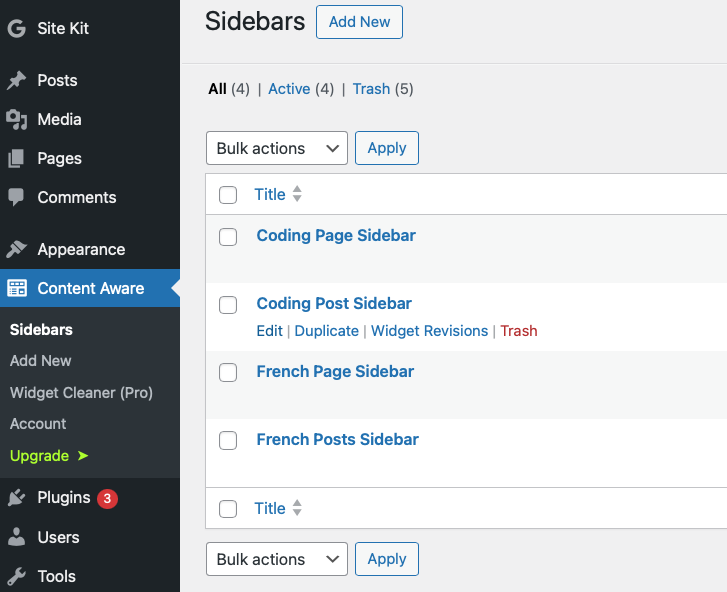
Here you can see the sidebar content specified for posts and pages for each blog.
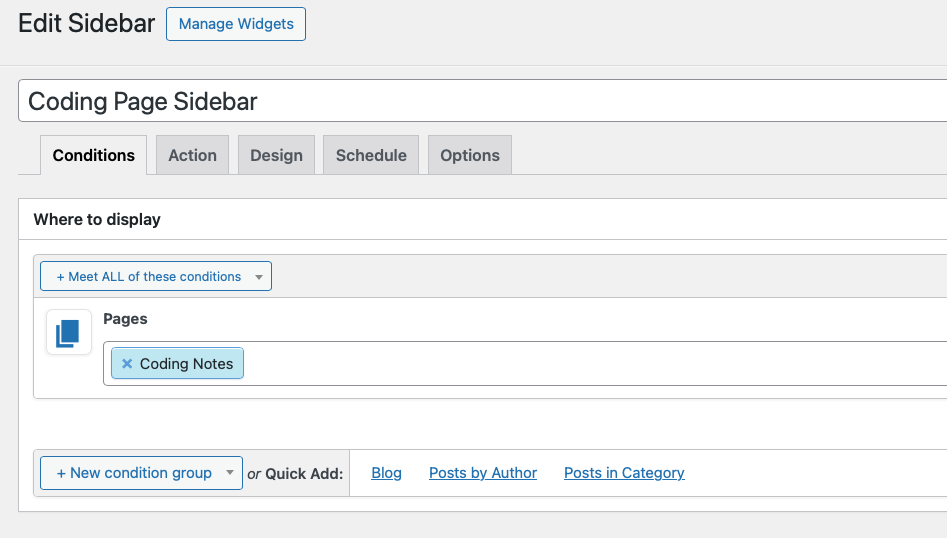
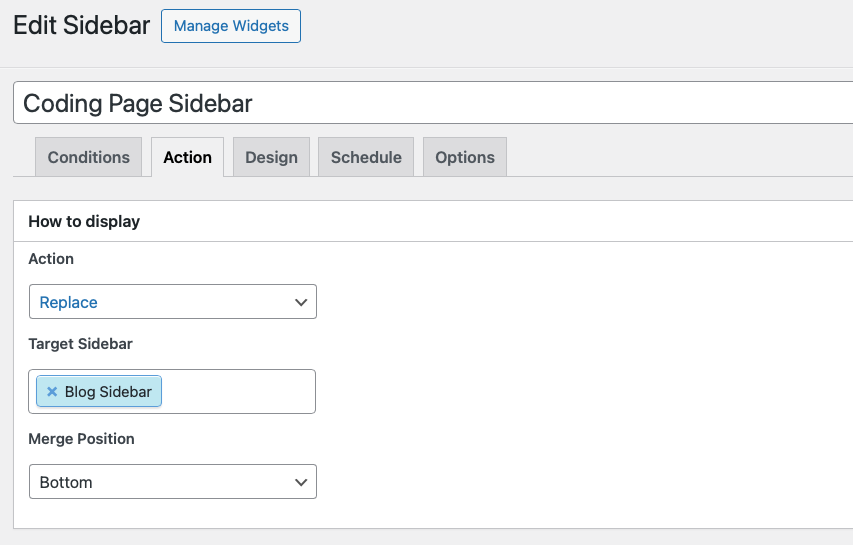
Then, within the Coding Page Sidebar, a condition and an action have been created.
Content Aware Sidebars configuration can be bit confusing at first, so the included screenshots should be helpful to understanding how to create a sidebar configuration. The plug-in does come with many more options, but it’s best to start simple then customize it as needed.
A Note of Caution
The amount of content that you can add to either blog depends on your hosting plan. If your plan allows a small amount of space but your blogs will contain video-rich content, then you may have to either upgrade your hosting plan or split your blogs into different sites sooner rather than later. If it’s a text and image-based site, you’ll have more time to develop your blogs before deciding to split them up.
Conclusion
You’ve seen one idea for how to separate multiple blogs on one WordPress site. The solution you create will most likely look different from mine because it depends on your theme and how far you push your customizations.
Whether technically savvy or not, the main goal is to control the sidebars, pages, posts and content that visitors will see. If you can devise a strategy for managing them you will be able to host multiple blogs with a reasonable amount of increased administrative overhead. Once you have these basic features configured, then you dig deeper into other parts of your blog such as your homepage and header menus.
How to build an agent using LangGraph. Try code locally by downloading from Github or run it in a Kaggle notebook.
"""
Build an agent with LangGraph

Google Gen AI 5-Day Intensive Course
Host: Kaggle

Day: 3

Codelab: https://www.kaggle.com/code/markishere/day-3-building-an-agent-with-langgraph/#IMPORTANT!
"""

from pprint import pprint
from typing import Annotated, Literal

from google import genai
from IPython.display import Image
from langchain_core.messages.ai import AIMessage
from langchain_core.tools import tool
from langchain_google_genai import ChatGoogleGenerativeAI
from langgraph.graph import END, START, StateGraph
from langgraph.graph.message import add_messages
from langgraph.prebuilt import ToolNode
from typing_extensions import TypedDict
from collections.abc import Iterable
from random import randint
from langchain_core.messages.tool import ToolMessage

class OrderState(TypedDict):
    """State representing the customer's order conversation."""

    # Preserves the conversaton history between nodes.
    # The 'add messages' annotation indicates to LangGraphthat state
    # is updated by appending returned messages, not replacing them.
    messages: Annotated[list, add_messages]

    # The customer's in-progress order.
    order: list[str]

    # Flag indicating that the order is placed and completed.
    finished: bool


# The system instruction defines how the chatbot is expected to behave
# and includes rules for when to call different functions,
# as well as rules for the conversation, such as tone and what is permitted
# for discussion.
BARISTABOT_SYSINT = (
    # 'system' indicates the message is a system instruction.
    "system",
    "You are a BaristaBot, an interactive cafe ordering system. A human will talk to you about the "
    "available products you have and you will answer any questions about menu items (and only about "
    "menu items - no off-topic discussion, but you can chat about the products and their history). "
    "The customer will place an order for 1 or more items from the menu, which you will structure "
    "and send to the ordering system after confirming the order with the human. "
    "\n\n"
    "Add items to the customer's order with add_to_order, and reset the order with clear_order. "
    "To see the contents of the order so far, call get_order (this is shown to you, not the user) "
    "Always confirm_order with the user (double-check) before calling place_order. Calling confirm_order will "
    "display the order items to the user and returns their response to seeing the list. Their response may contain modifications. "
    "Always verify and respond with drink and modifier names from the MENU before adding them to the order. "
    "If you are unsure a drink or modifier matches those on the MENU, ask a question to clarify or redirect. "
    "You only have the modifiers listed on the menu. "
    "Once the customer has finished ordering items, Call confirm_order to ensure it is correct then make "
    "any necessary updates and then call place_order. Once place_order has returned, thank the user and "
    "say goodbye!"
    "\n\n"
    "If any of the tools are unavailable, you can break the fourth wall and tell the user that "
    "they have not implemented them yet and should keep reading to do so.",
)

# This is the message with which the system opens the conversation.
WELCOME_MSG = "Welcome to the BaristaBot cafe. Type `q` to quit. How may I serve you today?"

# Define chatbot node
# This node will represent a single turn in a chat conversation
#
# Try using different models. The Gemini 2.0 flash model is highly capable, great with tools,
# and has a generous free tier. If you try the older 1.5 models, note that the 'pro' models are
# better at complex multi-tool cases like this, but the 'flas' models are faster and have more
# free quota.
#
# Check out the features and quota differences here:
#  - https://ai.google.dev/gemini-api/docs/models/gemini
llm = ChatGoogleGenerativeAI(model="gemini-2.0-flash")


def chatbot(state: OrderState) -> OrderState:
    """The chatbot itself. A simple wrapper around the model's own chat interface."""
    message_history = [BARISTABOT_SYSINT] + state["messages"]
    return {"messages": [llm.invoke(message_history)]}


# Set up the initial graph based on our state definition.
graph_builder = StateGraph(OrderState)

# Add the chatbot function to the app graph as a node called 'chatbot'.
graph_builder.add_node("chatbot", chatbot)

# Define the chatbot node as the app entrypoint.
graph_builder.add_edge(START, "chatbot")

chat_graph = graph_builder.compile()

# Render the graph to visualize it.
Image(chat_graph.get_graph().draw_mermaid_png())


# The defined graph only as one node.
# So the chat will begin at __start__, execute the chatbot node and terminate.
user_msg = "Hello, what can you do?"
state = chat_graph.invoke({"messages": [user_msg]})

# The state object contains lots of informaton. Uncomment the pprint lines to see it all.
pprint(state)

# Note that the final state now has 2 messages. Our HumanMessage, and an additional AIMessage.
for msg in state["messages"]:
    print(f"{type(msg).__name__}: {msg.content}")


# Can be executed as Python loop
# Here it is manually invoked once
user_msg2 = "Oh great, what kinds of latte can you make?"

state["messages"].append(user_msg2)
state = chat_graph.invoke(state)

# pprint(state)
for msg in state["messages"]:
    print(f"{type(msg).__name__}: {msg.content}")


# Add a human node
# LangGraph can be looped between nodes
# This node will display the last message from the LLM to the user,
# then prompt them for their next input.
def human_node(state: OrderState) -> OrderState:
    """Display the last model message to the user and get the user's input."""
    last_msg = state["message"][-1]
    print("Model:", last_msg.content)

    user_input = input("User: ")

    # If it looks like the user is trying to quit, flag the conversaton as over.
    if user_input in {"q", "quit", "exit", "goodbye"}:
        state["finished"] = True

    return state | {"messages": [("user", user_input)]}


def chatbot_with_welcome_msg(state: OrderState) -> OrderState:
    """The chatbot itself. A wrapper around the model's own chat interface."""

    if state["messages"]:
        # If there are messages, continue the conversation with the Gemini model.
        new_output = llm.invoke([BARISTABOT_SYSINT]) + state["messages"]
    else:
        # If there are no messages, start with the welcome message.
        new_output = AIMessage(content=WELCOME_MSG)

    return state | {"messages": [new_output]}


# Start building a new graph.
graph_builder = StateGraph(OrderState)

# Add the chatbot and human nodes to the app graph.
graph_builder.add_node("chatbot", chatbot_with_welcome_msg)
graph_builder.add_node("human", human_node)

# Start with the chatbot again.
graph_builder.add_edge(START, "chatbot")

# The chatbot will always go to the human next.
graph_builder.add_edge("chatbot", "human")


# Create a conditional edge
def maybe_exit_human_node(state: OrderState) -> Literal["chatbot", "__end__"]:
    """Route to the chatbot, unless it looks like the user is exiting."""
    if state.get("finished", False):
        return END
    else:
        return "chatbot"


graph_builder.add_conditional_edges("human", maybe_exit_human_node)

chat_with_human_graph = graph_builder.compile()

Image(chat_with_human_graph.get_graph().draw_mermaid_png)


# The default recursion limit for traversing nodes is 25 - setting it higher means
# you can try a more complex order with multiple steps and round-trips and you can chat for longer!
config = {"recursion_limit": 100}

# Remember that this will loop forever, unless you input 'q', 'quit' or one of the other exit terms
# defined in 'human_node'.
# Uncomment this line to execute the graph:
# state = chat_with_human_graph.invoke({"messages": []}, config)
#
# Things to try:
#   - Just chat! There's no ordering or menu yet.
#   - 'q' to exit.

pprint(state)


# Add a "live" menu
# To create a dynamic menu to respond to changing stock levels
# There are two types of tools: stateless and stateful
# Stateless tools run automatically: get current menu: it doesn't make changes
# Stateful tools modify the order
# In LangGraph Python functions can be annotated as tools by applying @tools annotation
@tool
def get_menu() -> str:
    """Provide the latest up-to-date menu."""
    # Note that this is just hard-coded text, but you could connect this to a live stock
    # database, or you could use Gemini's multi-modal capabilities and take like photos
    # of your cafe's chalk menu or the products on the counter, and assemble them into an input.

    return """
        MENU:
        Coffee Drinks:
        Espresso
        Americano
        Cold Brew

        Coffee Drinks with Milk:
        Latte
        Cappuccino
        Cortado
        Macchiato
        Mocha
        Flat White

        Tea Drinks:
        English Breakfast Tea
        Green Tea
        Earl Grey

        Tea Drinks with Milk:
        Chai Latte
        Matcha Latte
        London Fog

        Other Drinks:
        Steamer
        Hot Chocolate

        Modifiers:
        Milk options: Whole, 2%, Oat, Almond, 2% Lactose Free; Default option: whole
        Espresso shots: Single, Double, Triple, Quadruple; default: Double
        Caffeine: Decaf, Regular; default: Regular
        Hot-Iced: Hot, Iced; Default: Hot
        Sweeteners (option to add one or more): vanilla sweetener, hazelnut sweetener, caramel sauce, chocolate sauce, sugar free vanilla sweetener
        Special requests: any reasonable modification that does not involve items not on the menu, for example: 'extra hot', 'one pump', 'half caff', 'extra foam', etc.

        "dirty" means add a shot of espresso to a drink that doesn't usually have it, like "Dirty Chai Latte".
        "Regular milk" is the same as 'whole milk'.
        "Sweetened" means add some regular sugar, not a sweetener.

        Soy milk has run out of stock today, so soy is not available.
      """


# Add the tool to the graph
# Define the tools and create a "tools" node.
tools = [get_menu]
tool_node = ToolNode(tools)

# Attach the tools to the model so that it knows what it can call.
llm_with_tools = llm.bind_tools(tools)


def maybe_route_to_tools(state: OrderState) -> Literal["tools", "human"]:
    """Route between human or tool nodes, depending if a tool call is made."""
    if not (msgs := state.get("messages", [])):
        raise ValueError(f"No messages found when parsing state: {state}")

    # Only route based on the last message.
    msg = msgs[-1]

    # When the chatbot returns tool_calls, rout to the "tools" node.
    if hasattr(msg, "tool_calls") and len(msg.tool_calls) > 0:
        return "tools"
    else:
        return "human"


def chatbot_with_tools(state: OrderState) -> OrderState:
    """The chatbot with tools. A simple wrapper around the model's own chat interface."""
    defaults = {"order": [], "finished": False}

    if state["messages"]:
        new_output = llm_with_tools.invoke(
            [BARISTABOT_SYSINT] + state["messages"]
        )
    else:
        new_output = AIMessage(content=WELCOME_MSG)

    # Set up some defaults if not already set, then pass through the provided state,
    # overriding only the "messages" field.
    return defaults | state | {"messages": [new_output]}


graph_builder = StateGraph(OrderState)

# Add the nodes, including the new tool_node.
graph_builder.add_node("chatbot", chatbot_with_tools)
graph_builder.add_node("human", human_node)
graph_builder.add_node("tools", tool_node)

# Chatbot may go to tools, or human.
graph_builder.add_conditional_edges("chatbot", maybe_route_to_tools)
# Human may go back to chatbot, or exit.
graph_builder.add_conditional_edges("human", maybe_exit_human_node)

# Tools always route back to chat afterwards.
graph_builder.add_edge("tools", "chatbot")

graph_builder.add_edge(START, "chatbot")
graph_with_menu = graph_builder.compile()

Image(graph_with_menu.get_graph().draw_mermaid_png())


# Remember that you have not implemented ordering yet, so this will loop forever,
# unless you input `q`, `quit` or one of the other exit terms defined in the
# `human_node`.
# Uncomment this line to execute the graph:
state = graph_with_menu.invoke({"messages": []}, config)

# Things to try:
# - I'd love an espresso drink, what have you got?
# - What teas do you have?
# - Can you do a long black? (this is on the menu as an "Americano" - see if it can
#   figure it out)
# - 'q' to exit.

pprint(state)


# Handle orders
# Update state to track an order and provide simple tools that update the state.
# You will need to be explicit as the model should not directly have access to
# the app's internal state.
#
# These functions have no body; LangGraph does not allow @tools to update the
# conversation state, so you will implement a separate node to handle state
# updates.

@tool
def add_to_order(drink: str, modifiers: Iterable[str]) -> str:
    """Adds the specified drink to the customer's order, including any modifiers.

    Returns:
        The updated order in progress.
    """

@tool
def confirm_order() -> str:
    """Asks customer if the order is correct.

    Returns:
        The user's free-text response.
    """

@tool
def get_order() -> str:
    """Returns the users order so far. One item per line."""


@tool
def clear_order():
    """Removes all items from the user's order."""


@tool
def place_order() -> int:
    """Sends the order to the barista for fulfillment.

    Returns:
      The estimated number of minutes until the order is ready.
    """

def order_node(state: OrderState) -> OrderState:
    """The ordering node. This is where the order state is manipulated."""
    tool_msg = state.get("messages", [])[-1]
    order = state.get("order", [])
    outbound_msgs = []
    order_placed = False

    for tool_call in tool_msg.tool_calls:
        if tool_call["name"] == "add_to_order":
            # Each order item is just a string. This is where it is assembled.
            # as "drink (modifiers, ...)".
            modifiers = tool_call["args"]["modifiers"]
            modifier_str = ", ".join(modifiers) if modifiers else "no modifiers"

            order.append(f"{tool_call["args"]["drink"]} ({modifier_str}))
            response = "\n".join(order)
        elif tool_call["name"] == "confirm_order":
            # We could entrust the LLM to do order confirmation, but it is a good practice to
            # show the user the exact data that comprises their order so that what they confirm
            # precisely matches the order that goes to the kitchen - avoiding hallucination
            # or reality skew.

            # In a real scenario, this is where you would connect your POS screen to show the
            # order to the user.

            print("Your order:")
            if not order:
                print(" (no items)")

            for drink in order:
                print(f" {drink}")

            response = input("Is this correct?")
        elif tool_call["name"] == "get_order":
            response = "\n".join(order) if order else "(no order)"
        elif tool_call["name"] == "clear_order":
            order.clear()
            response = None
        elif tool_call["name"] == "place_order":
            order_text = "\n".join(order)
            print("Sending order to kitchen!")
            print(order_text)

            # TODO: Implement cafe.
            order_placed = True
            response = randint(1, 5) # ETA in minutes
        else:
            raise NotImplementedError(f"Unknown tool call: {tool_call["name"]}")

        # Record the tool results as tool message.
        outbound_msgs.append(
            ToolMessage(
                content=response,
                name=tool_call["name"],
                tool_call_id=tool_call["id"]
            )
        )

    return {"messages": outbound_msgs, "order": order, "finished": order_placed}

def maybe_route_to_tools(state: OrderState) -> str:
    """Route between chat and tool nodes if a tool call is made."""
    if not (msgs := state.get("messages", [])):
        raise ValueError(f"No messages found when parsing state: {state}")

msg = msgs[-1]

if state.get("finished", False):
    # When an order is placed, exit the app. The system instruction indicates
    # that the chatbot should say thanks and goodbye at this point, so we can exit
    # cleanly.
    return END
elif hasattr(msg, "tool_calls") and len(msg.tool_calls) > 0:
    # Route to 'tools' node for any automated tool calls first.
    if any(
        tool["name"] in tool_node.tools_by_name,keys() for tool in msg.tool_calls
    ):
        return "tools"
    else:
        return "ordering"
    else:
        return "human"

# Define the graph so the LLM knows about the tools to invoke them.
# Auto-tools will be invoked automatically by the ToolNode
auto_tools = [get_menu]
tool_node = ToolNode(auto_tools)

# Order-tools will be handled by the order node.
order_tools = [add_to_order, confirm_order, get_order, clear_order, place_order]

# The LLM needs to know about all of the tools, so specify everything here
llm_with_tools = llm.bind_tools(auto_tools + order_tools)


graph_builder = StateGraph(OrderState)

# Nodes
graph_builder.add_node("chatbot", chatbot_with_tools)
graph_builder.add_node("human", human_node)
graph_builder.add_node("tools", tool_node)
graph_builder.add_node("ordering", order_node)

# Chatbot -> (ordering, tools, human, END)
graph_builder.add_conditional_edges("chatbot", maybe_route_to_tools)
# Human -> (chatbot, END)
graph_builder.add_conditional_edges("human", maybe_exit_human_node)

# Tools (both kinds) always route back to chat afterwards.
graph_builder.add_edge("tools", "chatbot")
graph_builder.add_edge("ordering", "chatbot")

graph_builder.add_edge(START, "chatbot")
graph_with_order_tools = graph_builder.compile()

Image(graph_with_order_tools.get_graph().draw_mermaid.png())


# Uncomment this line to execute the graph:
state = graph_with_order_tools.invoke({"messages": []}, config)

# Things to try:
# - Order a drink!
# - Make a change to your order.
# - "Which teas are from England?"
# - Note that the graph should naturally exit after placing an order.

pprint(state)

# Uncomment this once you have run the graph from the previous cell.
pprint(state["order"])
When learning a new language, as I’m currently pursuing with French, once you get past the basics of conjugation, grammar and pronunciation, becoming fluent requires a deeper understanding of the language. It is necessary to not only know how to speak the language but also know the nuances of a langauge including common usage patterns, useful related phrases, and linguistic and historical facts. How certain phrases are commonly use. What does it sound like spoken versus written. What language rules cause a change in spelling and word groupings. These are all insights that would be helpful to me as a second language learner to have when studying a language.
For example, in French the phrase “pas de” doesn’t change even if it is followed by a plural noun. It is used as “pas de viandes” as well as “pas de fromage”. This and other similar examples enrich and enhance french-language learning. A language learner has to be able to take notes on these variations and practice them.
Goals
During my studies, I often have to use multiple websites and apps to get the additional information I need to understand the grammar, spelling, and language rules to name a few. Often, It’s more helpful to get additional details and examples.
The goal of my project was to create a French language advisor to help me achieve my goal of being fluent in the French language. Currently, I am working to be fluent in French and I’m currently at CEFR 43 where I can read, write and speak about every things. At this point in my learning, it’s important to understand and explore the language nuances to foster thinking “in French”, versus just learning grammar, vocabulary, and conjugations.
I wanted to see if a chatbot could eliminate the need for multiple apps and websites to get the information I need.
The goals were to:
Create a model that can use an agent, Google Search grounding, and retrieval augmented generation (RAG) to supplement and support my French language studies
Have the model offer suggestions, ideas, examples and interesting information and facts about the French language
Include something interesting, funny and/or popular culture references
Features
The primary feature of the model was to give me the ability to ask any question and receive results that may refer to embedded texts (RAG) or Google search results. I needed the ability to input a word, phrase or sentence in French, and receive an appropriate response, preferably in French.
Chatbot features
Get interesting French language details including grammar, composition, and spelling with Google search grounding.
Create a domain-specific LLM: Add French language notes and documents
Use existing texts as input for RAG to reference French textbooks and documents
LangGraph to manage the conversation and its details
Implementation
This solution leverages LangGraph, Gemini’s Google Search, RAG and functions. The steps used to implement this solution are outlined here. The initial stages of my project were to create a basic graph that included Google searches, client instantiation and creating embeddings. Once that was tested then add and integrate RAG to provide a richer learning experience.
Prepare Data: The PDFs for RAG are French-language textbooks that were imported then converted to Documents (object type) before embedding them using Google’s models/text-embedding-004. Once the embeddings were created, they were stored in a Chroma vectorstore database.
defcreate_embeddings(text:str)-> List[float]:"""Create embeddings for a given text.""" response = client.models.embed_content(model=EMBEDDING_MODEL,contents=text,config=types.EmbedContentConfig(task_type="semantic_similarity"),)return response.embeddings
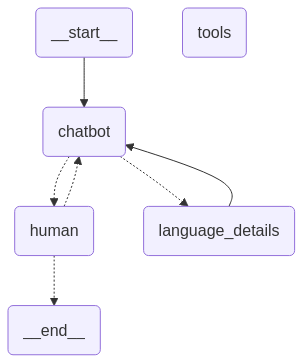
Build Agents & Functions: The chatbot consists of LangGraph nodes, functions, conditional edges and edges as seen in this mermaid graph.
Search grounding: Google search is used to return augmented results such as common usage examples and conjugations. The wrapper used is ChatGoogleGenerativeAI. It’s part of the langchain_google_genai package. It was configured with temperature and top_p.
LangGraph Nodes: This was the most challenging for me as I had to first learn LangGraph beyond the codelabs to understand it. Once I understood, I was able to create and sequence the nodes and edges to get the model behavior and output that I wanted.
# Create and display the graphworkflow.add_node("chatbot", chatbot)workflow.add_node("human", human_node)workflow.add_node("tools", tools_node)workflow.add_node("language_details", language_details_node)# Chatbot may go to tools, or human.workflow.add_conditional_edges("chatbot", maybe_route_to_tools)# Human may go back to chatbot, or exit.workflow.add_conditional_edges("human", maybe_exit_human_node)# Define chatbot node edgesworkflow.add_edge("language_details","chatbot")# Set graph start and compileworkflow.add_edge(START,"chatbot")workflow_with_translation_tools = workflow.compile()
Reflection and Learning
Prior to participating in the Google Gen AI 5-Day Intensive, I was unfamiliar with LangGraph, RAG, and agents. Now, I understand the flexibility and promise of LangGraph, RAG and agentic LLMs to allow models to be more flexible and relevant.
Some of what I’ve had to learn are following:
The types Gemini models I can use for embedding and the chatbot. In this case, I used the text-embedding-004 embedding model without experiencing any issues.
How to configure chatbot and embedding clients. Both clients were easy to configure and were set once and done.
How Google AI can be used in a LangGraph graph. I used two major packages, GoogleGenerativeAIEmbeddings and ChatGoogleGenerativeAI. Using either package was easy because the API and code documentaion was very good.
The difference between conditional edges and edges and how to create them. This was a bit tricky to decide what should be a tool versus a function for a conditional edge, versus a node. I also had to consider which logic should be place where and how the output should be handled. It took several graph iterations to get almost the way I like it. For the purposes of the capstone, it works as I intended.
How to import and extract text from PDFs. Importing and extracting text from PDF files was easy, as long as the PDF contained actual text and not images. To keep the scope of the project within my timeframe, I only wanted to work with PDFs that contained text.
How to embed documents for RAG contexts. Document embedding took several minutes for three decent-sized PDFs. It was the most time-consuming part of testing. It’s easy to see where as the set of documents I embed grows, more time and resources will be required.
Creating a Chroma vectorstore database. Creating and retrieving the vectorstore contents was fairly straightforward. It worked consistently locally and in the Kaggle Notebook.
Creating, updating and accessing a graph’s State object. I would have liked to have more time to master the state object but I was able to understand enough to make it work for my project. I would have liked to customize the state more but didn’t have the time to do so. I did find it to be a convenient resource to access messages no matter where it was invoked in the graph.
Create multiple tools and nodes to be used in the graph. I knew what tools I wanted to include based on the resources and tools I currently use when studying French. The goal was to consolidate the information I receive from multiple sources into a single one. But, there are other tools that would enrich my learning. For example, the ability to get rich text and image responses.
Using a prompt template to create and use basic prompts. I didn’t get as much time to investigate creating and using PromptTemplates. I know they could be useful for managing and transforming user input and I will be exploring them further beyond this project.
In addition, since I wrote the code locally in Zed, it took some time and effort to transform the code for a Kaggle notebook. One of the issues I had was that the dependencies initially installed in Kaggle’s environment caused import and dependency resolution errors. It took some time to make sure that the dependencies that worked locally were the same on Kaggle. In hindsight, I’m glad I developed it locally versus starting in a notebook
The Bigger Picture
Thinking beyond this capstone project, language learners need a wise companion to provide information and guidance. The companion would be a language note-taking app with an AI companion that would make suggestions about language rules, common usages, examples and comparisons. While taking notes, or when asked a question, an AI companion would be displayed in a sidebar with context rich details, and unique information and historical facts. This way, as they learn, they get to consider and contrast what they’ve learned. This would create a richer learning environment to motivate and encourage fluency. It can include images too.
This project is about taking the first steps to creating such a companion that will use the keywords, phrases and sentences I input to give me more context and nuance about it’s meaning, common usage patterns and interesting cultural and historical facts. It’s about going beyond the basics to to become immersed in French, especially if you don’t get to live in or visit a francophone country.
Ultimately, it can be developed into an AI-enabled, context-aware application. The AI integrated into the app would be a wise language advisor to help me learn the language. This would be similar to what happens currently with AI-enabled coding apps such as Zed, but more engaging. The AI assistant would remain aware of what I’m typing and offer context-rich suggestions. It would also allow the user to provide instruction at the start of the session for what their learning target is. Once the AI has this, it can then provide a richer learning experience.
This chatbot is the first step in realizing this vision. I can now input anything in french get a variety of details about it, including making additional requests for grammar, gender, and popular culture details.
The next steps for my French language assistant is to continue refine and update the graph, then create a user-friendly interface, before considering an app or website.
Codelab 2/2 from day one. The code lab is here in Kaggle. Download the code on Github to run it locally.
"""
Prompting

Google Gen AI 5-Day Intensive Course
Host: Kaggle

Day: 1

Codelab: https://www.kaggle.com/code/reniseblack/day-1-evaluation-and-structured-output/edit
"""

import enum
import io
import os
from pprint import pprint

import typing_extensions as typing
from google import genai
from google.api_core import retry
from google.genai import types
from IPython.display import Markdown, clear_output, display

is_retriable = lambda e: (  # noqa: E731
    isinstance(e, genai.errors.APIError) and e.code in {429, 503})

genai.models.Models.generate_content = retry.Retry(
    predicate=is_retriable)(genai.models.Models.generate_content)

client = genai.Client(api_key=os.environ["GOOGLE_API_KEY"])

# Create and send a single-turn prompt
MODEL = "gemini-2.0-flash"
prompt = "Explain AI to me like I'm a kid."
response = client.models.generate_content(
    model=MODEL,
    contents=prompt
)

# Get the response text then render as HTML (optional)
response_text = response.text
print("Model response: \n\n", Markdown(response.text))
section_break = "----------------------------"
print(section_break, "\n\nStarting a multi-turn chat ...\n\n")


# Start a multi-turn chat
chat_message = "Hello! My name is Zlork."
chat = client.chats.create(model=MODEL, history=[])
response = chat.send_message(chat_message)

print(response.text)

chat_message2 = "Can you tell me something interesting about dinosaurs?"
response = chat.send_message(chat_message2)

print(response.text)

chat_message3 = "Do you remember my name?"
response = chat.send_message(chat_message3)

print(response.text)


# See the list of available models
print("\n\nGetting a list of available models ... \n\n")

for model in client.models.list():
    print(model.name)

print("\n\nGetting a list of gemini-2.0-flash models ... \n\n")

for model in client.models.list():
    if model.name == 'models/gemini-2.0-flash':
        pprint(model.to_json_dict())
        break


# Set token limit to restrict output length
print("\n\nSetting a token limit ... \n\n")
short_config = types.GenerateContentConfig(max_output_tokens=200)
PROMPT_2 = ('Write a 1000 word essay on the importance of olives in modern '
            'society.')
response = client.models.generate_content(
    model=MODEL,
    config=short_config,
    contents=PROMPT_2
)

print(response.text)
print("\n\n")

PROMPT_3 = "Write a short poem on the importance of olives in modern society."
# config is where you specify top_k, temperature, etc
response = client.models.generate_content(
    model=MODEL,
    config=short_config,
    contents=PROMPT_3
)

print(response.text)
print("\n\n")

short_config = types.GenerateContentConfig(max_output_tokens=100)
response = client.models.generate_content(
    model=MODEL,
    config=short_config,
    contents='Write a 150 opinion about the importance of pine trees.')

print(response.text)
print("\n\n")
print("\n\nSetting a temperature limit ... \n\n")

# Set a temperature that helps manage the randomness
high_temp_config = types.GenerateContentConfig(temperature=2.0)
PROMPT_4 = "Pick a random colour... (respond in a single word)"
for _ in range (5):
    response = client.models.generate_content(
        model=MODEL,
        config=high_temp_config,
        contents = PROMPT_4
    )

    if response.text:
        print(response.text, "-" * 25)

print("\n\n")
print("\n\nSetting a low temperature ... \n\n")

# Setting a low temperature
low_temp_config = types.GenerateContentConfig(temperature=0.0)
for _ in range(5):
    response = client.models.generate_content(
        model=MODEL,
        config=low_temp_config,
        contents = PROMPT_4
    )

    if response.text:
        print(response.text, "-" * 25)

print("\n\n")
print("\n\nSetting top-p ... \n\n")

# Setting top-p that also controls output diversity
# It will determine when to stop selecting tokens that are least probable
TEMPERATURE_2 = 1.0
TOP_P1 = 0.05
model_config = types.GenerateContentConfig(
    # These are default gemini-2.0-flash values
    temperature=TEMPERATURE_2,
    top_p=TOP_P1
)

STORY_PROMPT = ("You are a creative writer. Write a short story about a cat"\
    "who goes on an adventure.")
response = client.models.generate_content(
    model=MODEL,
    config=model_config,
    contents=STORY_PROMPT
)

print(response.text)
print("\n\n")
print("\n\nSetting top-p ... \n\n")

# Create a zero-shot prompt
TEMPERATURE_2 = 0.1
TOP_P2 = 1
MAX_OUTPUT_TOKENS = 5
model_config = types.GenerateContentConfig(
    temperature=TEMPERATURE_2,
    top_p=TOP_P2,
    max_output_tokens=MAX_OUTPUT_TOKENS,
)

ZERO_SHOT_PROMPT = """Classify movie reviews as POSITIVE, NEUTRAL or NEGATIVE.
Review: "Her" is a disturbing study revealing the direction
humanity is headed if AI is allowed to keep evolving,
unchecked. I wish there were more movies like this masterpiece.
Sentiment: """

response = client.models.generate_content(
    model=MODEL,
    config=model_config,
    contents=ZERO_SHOT_PROMPT)

print(response.text)
print("\n\n")
print("\n\nSetting top-p ... \n\n")

# Setting enum mode
class Sentiment(enum.Enum):
    POSITIVE = "right on"
    NEUTRAL = "meh"
    NEGATIVE = "sucks lemons"

ENUM_TYPE = "text/x.enum"
response = client.models.generate_content(
    model=MODEL,
    config=types.GenerateContentConfig(
        response_mime_type=ENUM_TYPE,
        response_schema=Sentiment
    ),
    contents=ZERO_SHOT_PROMPT)

print(response.text)
print("\n\n")
print("\n\nSetting top-p ... \n\n")


# Get the Sentiment returned as a Python object
enum_response = response.parsed
print(enum_response)
print(type(enum_response))
print("\n\n")
print("\n\nSetting top-p ... \n\n")


# Send one-shot and few-shot prompts
FEW_SHOT_PROMPT = """Parse a customer's pizza order into valid JSON:

EXAMPLE:
I want a small pizza with cheese, tomato sauce, and pepperoni.
JSON Response:
```
{
"size": "small",
"type": "normal",
"ingredients": ["cheese", "tomato sauce", "pepperoni"]
}
```

EXAMPLE:
Can I get a large pizza with tomato sauce, basil and mozzarella
JSON Response:
```
{
"size": "large",
"type": "normal",
"ingredients": ["tomato sauce", "basil", "mozzarella"]
}
```

ORDER:
"""

CUSTOMER_ORDER = "Give me a large with cheese & pineapple"
MAX_OUTPUT_TOKENS = 250
response = client.models.generate_content(
    model='gemini-2.0-flash',
    config=types.GenerateContentConfig(
        temperature=TEMPERATURE_2,
        top_p=TOP_P2,
        max_output_tokens=MAX_OUTPUT_TOKENS,
    ),
    contents=[FEW_SHOT_PROMPT, CUSTOMER_ORDER])

print(response.text)
print("\n\n")
print("\n\nSet to JSON response only ... \n\n")


# Set output to JSON format
class PizzaOrder(typing.TypedDict):
    size: str
    ingredients: list[str]
    type: str

ORDER_1 = "Can I have a large dessert pizza with apple and chocolate"
response = client.models.generate_content(
    model=MODEL,
    config=types.GenerateContentConfig(
        temperature=TEMPERATURE_2,
        response_mime_type="application/json",
        response_schema=PizzaOrder
    ),
    contents=ORDER_1
)

print(response.text)
print("\n\n")
print("\n\nUse Chain of Thought (CoT) ... \n\n")


# Use Chain of Thought (CoT) to show reasoning to check hallucinations
CHAIN_OF_THOUGHT_PROMPT = """When I was 4 years old,
my partner was 3 times my age. Now, I am 20 years old.
How old is my partner? Return the answer directly."""

response = client.models.generate_content(
    model=MODEL,
    contents=CHAIN_OF_THOUGHT_PROMPT
)

print(response.text)
print("\n\n")
print("\n\nUse Chain of Thought (CoT) with step-by-step ... \n\n")


# Use Chain of Thought (CoT) to show reasoning to check hallucinations
CHAIN_OF_THOUGHT_PROMPT_2 = """When I was 4 years old, my partner was 3 times
my age. Now, I am 20 years old. How old is my partner?
Let's think step by step."""

response = client.models.generate_content(
    model=MODEL,
    contents=CHAIN_OF_THOUGHT_PROMPT_2
)

Markdown(response.text)
print("\n\n")
print("\n\nReAct prompt examples ... \n\n")


# Examples of ReAct prompts
model_instructions = """
Solve a question answering task with interleaving Thought, Action, Observation
steps. Thought can reason about the current situation,
Observation is understanding relevant information from an Action's output and
Action can be one of three types:
 (1) <search>entity</search>, which searches the exact entity on Wikipedia and
     returns the first paragraph if it exists. If not, it will return some
     similar entities to search and you can try to search the information from
     those topics.
 (2) <lookup>keyword</lookup>, which returns the next sentence containing
     keyword in the current context. This only does exact matches, so keep your
     searches short.
 (3) <finish>answer</finish>, which returns the answer and finishes the task.
"""

example1 = """Question
Musician and satirist Allie Goertz wrote a song about the "The Simpsons" ch\
aracter Milhouse, who Matt Groening named after who?

Thought 1
The question simplifies to "The Simpsons" character Milhouse is named after \
who. I only need to search Milhouse and find who it is named after.

Action 1
<search>Milhouse</search>

Observation 1
Milhouse Mussolini Van Houten is a recurring character in the Fox animated \
television series The Simpsons voiced by Pamela Hayden and
created by Matt Groening.

Thought 2
The paragraph does not tell who Milhouse is named after, maybe I can look u\
p "named after".

Action 2
<lookup>named after</lookup>

Observation 2
Milhouse was named after U.S. president Richard Nixon, whose middle name wa\
s Milhous.

Thought 3
Milhouse was named after U.S. president Richard Nixon, so the answer is Ric\
hard Nixon.

Action 3
<finish>Richard Nixon</finish>
"""

example2 = """Question
What is the elevation range for the area that the eastern sector of the
Colorado orogeny extends into?

Thought 1
I need to search Colorado orogeny, find the area that the eastern sector
of the Colorado orogeny extends into, then find the elevation range
of the area.

Action 1
<search>Colorado orogeny</search>

Observation 1
The Colorado orogeny was an episode of mountain building (an orogeny) in Colora
do and surrounding areas.

Thought 2
It does not mention the eastern sector. So I need to look up eastern sector.

Action 2
<lookup>eastern sector</lookup>

Observation 2
The eastern sector extends into the High Plains and is called the Central Plain
s orogeny.

Thought 3
The eastern sector of Colorado orogeny extends into the High Plains. So I need
to search High Plains and find its elevation range.

Action 3
<search>High Plains</search>

Observation 3
High Plains refers to one of two distinct land regions

Thought 4
I need to instead search High Plains (United States).

Action 4
<search>High Plains (United States)</search>

Observation 4
The High Plains are a subregion of the Great Plains. From east to west, the
High Plains rise in elevation from around 1,800 to 7,000 ft (550 to 2,130m).

Thought 5
High Plains rise in elevation from around 1,800 to 7,000 ft, so the answer is 1
,800 to 7,000 ft.

Action 5
<finish>1,800 to 7,000 ft</finish>
"""

question = """Question
Who was the youngest author listed on the transformers NLP paper?
"""

# You will perform the Action; so generate up to, but not including,
# the Observation.
react_config = types.GenerateContentConfig(
    stop_sequences=["\nObservation"],
    system_instruction=model_instructions + example1 + example2,
)

# Create a chat that has the model instructions and examples pre-seeded.
react_chat = client.chats.create(
    model=MODEL,
    config=react_config,
)

response = react_chat.send_message(question)
print(response.text)
print("\n\n")
print("\n\nAdding an observation with author names ... \n\n")


# The model won't find the authors, so supply them with a followup
observation = """Observation 1
[1706.03762] Attention Is All You Need
Ashish Vaswani, Noam Shazeer, Niki Parmar, Jakob Uszkoreit, Llion Jones, Aidan
N. Gomez, Lukasz Kaiser, Illia Polosukhin
We propose a new simple network architecture, the Transformer, based solely on
attention mechanisms, dispensing with recurrence and convolutions entirely.
"""
response = react_chat.send_message(observation)
print(response.text)
print("\n\n")
print("\n\nUse Gemini 2.0 Flash Thinking Mode ... \n\n")


# Examples of ReAct prompts
THINKING_MODE_MODEL = "gemini-2.0-flash-thinking-exp"
THINKING_MODE_PROMPT = ("Who was the youngest author listed on the "
    "transformers NLP paper?")
response = client.models.generate_content_stream(
    model=THINKING_MODE_MODEL,
    contents=THINKING_MODE_PROMPT
)

buffer = io.StringIO()
for chunk in response:
    buffer.write(str(chunk.text))
    # Display the response as it is streamed
    print(chunk.text, end='')

# Render the response as formatted markdown
clear_output()
Markdown(buffer.getvalue())
print("\n\n")
print("\n\nUse Gemini 2.0 to generate code ... \n\n")


# Generate code wth Gemini
# The Gemini models love to talk, so it helps to specify they stick to the code
# if that is all that you want.
CODE_PROMPT = """Write a Python function to calculate the factorial of a number.
    No explanation, provide only the code."""

response = client.models.generate_content(
    model=MODEL,
    config=types.GenerateContentConfig(
        temperature=1,
        top_p=1,
        max_output_tokens=1024,
    ),
    contents=CODE_PROMPT)

Markdown(response.text)
print("\n\n")
print("\n\nUse Gemini 2.0 to execute code ... \n\n")


# Execute code wth Gemini
config = types.GenerateContentConfig(
    tools=[types.Tool(code_execution=types.ToolCodeExecution())],
)

code_exec_prompt = """
Generate the first 14 odd prime numbers, then calculate their sum.
"""

response = client.models.generate_content(
    model=MODEL,
    config=config,
    contents=code_exec_prompt)

for part in response.candidates[0].content.parts:
    pprint(part.to_json_dict())
    print("-----")

print("\n\n")
print("\n\nSee more parts of the response ... \n\n")


# See executable_code and code_execution_result
for part in response.candidates[0].content.parts:
    if part.text:
        display(Markdown(part.text))
    elif part.executable_code:
        display(Markdown(f'```python\n{part.executable_code.code}\n```'))
    elif part.code_execution_result:
        if part.code_execution_result.outcome != 'OUTCOME_OK':
            display(Markdown(f'## Status {part.code_execution_result.outcome}'))

        display(Markdown(f'```\n{part.code_execution_result.output}\n```'))

print("\n\n")
print("\n\nExplaining code ... \n\n")


# Get an explanation for code
# file_contents = !curl https://raw.githubusercontent.com/magicmonty/bash-git-prompt/refs/heads/master/gitprompt.sh

explain_prompt = f"""
Please explain what this file does at a very high level. What is it,
and why would I use it?

```
{file_contents}
```
"""

response = client.models.generate_content(
    model='gemini-2.0-flash',
    contents=explain_prompt)

Markdown(response.text)
Contains information related to marketing campaigns of the user. These are shared with Google AdWords / Google Ads when the Google Ads and Google Analytics accounts are linked together.
90 days
__utma
ID used to identify users and sessions
2 years after last activity
__utmt
Used to monitor number of Google Analytics server requests
10 minutes
__utmb
Used to distinguish new sessions and visits. This cookie is set when the GA.js javascript library is loaded and there is no existing __utmb cookie. The cookie is updated every time data is sent to the Google Analytics server.
30 minutes after last activity
__utmc
Used only with old Urchin versions of Google Analytics and not with GA.js. Was used to distinguish between new sessions and visits at the end of a session.
End of session (browser)
__utmz
Contains information about the traffic source or campaign that directed user to the website. The cookie is set when the GA.js javascript is loaded and updated when data is sent to the Google Anaytics server
6 months after last activity
__utmv
Contains custom information set by the web developer via the _setCustomVar method in Google Analytics. This cookie is updated every time new data is sent to the Google Analytics server.
2 years after last activity
__utmx
Used to determine whether a user is included in an A / B or Multivariate test.
18 months
_ga
ID used to identify users
2 years
_gali
Used by Google Analytics to determine which links on a page are being clicked
30 seconds
_ga_
ID used to identify users
2 years
_gid
ID used to identify users for 24 hours after last activity
24 hours
_gat
Used to monitor number of Google Analytics server requests when using Google Tag Manager